Part 1: Mike Wellins
Part 2: Robin Ator [You Are Here]
Part 3: Albert Hensley
Quick Context
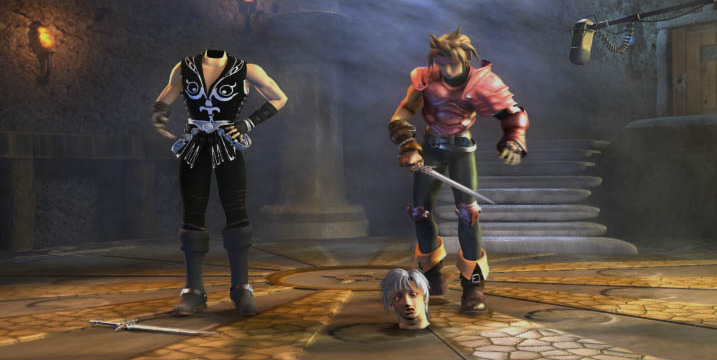
Several commercials were produced for LoD, but only one aired in North America. It’s a 30 second spot focusing on some fast cuts from the game’s Full-Motion Videos, or FMVs. However, it suddenly shifts to the arena fight between Dart and Lloyd. At the end, Dart manages to accidentally cut off Lloyd’s head. The scene goes from serious to silly, revealing stage elements like a boom mic and the Director telling everyone to take a break. But this didn’t really tell you what the game was about, or why you should buy it. Was it a game that was more like a movie? A funny game where peoples’ heads get chopped off? We had no idea for decades.
DrewUniverse was able to learn about this commercial from the first-hand account of multiple people who worked on it. This is part 2, as recounted by Robin Ator. Unlike most interviews, this series merely conveys the story as told by the people who worked on the commercial. A compiled account will be summarized and published on this website in 2026.
The ad agency Chiat Day (in Los Angeles, CA), were hired by Sony to find a production studio to create the TV spot. They would decide to go with Will Vinton Studios: known for claymation, TV spots, et cetera.
** Please note that the below transcript is provided as-is from the original email exchange. Issues with grammar, missing words, and stuff like that will not be revised on this page.
Part 2: The Story from Robin Ator
I’m happy to share what slight info I have, which isn’t much, and is essentially the same as Mike’s recollections. I do recall the two creatives, and recall being nonplussed by their proposal, since they had no real clue about how much they were asking inside a comically short time frame.
But this sort of thing is normal in the commercial animation world. We are constantly having to explain process to people who should already understand it, and worse, having to explain visual storytelling itself.
This all occurred during the studio’s Lightwave-to-Maya switch. My own job as storyboarder meant jumping from project to project, CG to stop-mo, trying to provide preliminary visuals for a string of job pitches on one hand, or working on refining edits for jobs in production.
This particular job went into production mode so quickly, due to the fast schedule, that my board work was barely more than a few poses against vague backgrounds, really only an excuse to map out the timing of the sequence. The main focus was not my design ideas at all, but on Mike and the crew rigging and animating the characters, getting them to function. I didn’t save any of the boards.
So there you are. I’m an occasional freelancer now, and spend my time teaching storyboarding at Pacific Northwest College of Art. Would like to work on an animated half-hour show again sometime.
As told by Robin Ator
Part 1: Mike Wellins
Part 2: Robin Ator [You Are Here]
Part 3: Albert Hensley